Sanctuary Line by Jane Urquhart
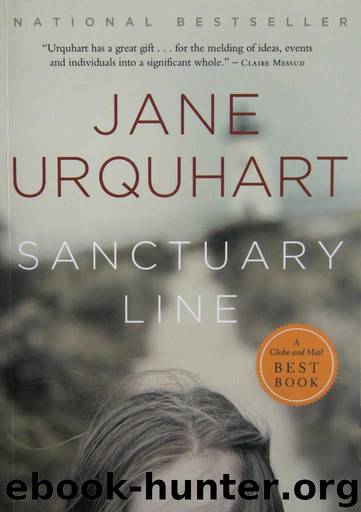
Author:Jane Urquhart
Language: eng
Format: mobi, epub
ISBN: 9780771086472
Publisher: McClelland & Stewart
Published: 2010-08-31T04:00:00+00:00
As I’ve told you, my uncle loved to talk about the bifurcating lighthouse-keepers of our family, those who kept the “lights” of Ireland, as well as the later nineteenth-century American Butler keepers, as he called them, in spite of the fact that the most significant member of their ranks had ultimately migrated to Canada and settled not at all far from the farm on which the tales were told. “Born American,” he would say, if anyone dared to correct this detail, “came here only in defeat.” My mother, having sat beside her brother while the previous generation’s adults told these stories during the course of her own childhood, still maintains the belief that American lighthouses were bigger and better than their Canadian counterparts, whiter, brighter, their lamps travelling farther into a storm, more successful, and the keepers, except for one notable exception, more dependable. The Irish-American Butler farmers had similar gifts, apparently. They were taller, stronger, had better horses, more sons, endured fewer crop failures, built more attractive houses, and stuck to their guns, literally and figuratively. They had a prosperous and rewarding nineteenth century, their lives unfolding near calmer waters or on richer soil, already well established while their brothers, the Upper Canadian Butlers, chopped wood and dug wells and threw up hastily built dwellings. “Except for our beautiful stone house,” she would add, “built by my great-great-grandfather, who, though foolish in his allegiances,” meaning his loyalty to the Crown, “at least had some sense when it came to housing his family.”
There is hardly anything left of the nineteenth century now on the north side of the lake. The remaining barns in our township have been reduced to skeletons; you can see their graceful beams and rafters, the gaping spaces that would have been their wide entrance doors, and sometimes a last load of hay in a sagging mow, placed there years ago by a farmer who either lost heart or died or both. Occasionally an oxen yoke can be seen fastened between two upright boards, or a harness hanging from a nail on what would have been a stall. These old essentials, of no use now except as objects of curiosity, seem almost to have become part of the decaying structure simply because they have not been moved or touched for so long. Most of the old frame houses have been replaced by newer models, or torn down and not replaced at all, their foundations ploughed under the huge fields of factory farms. Other, smaller fields go back to bush if they are of no use to the agri-industry, or if they have not caught the eye of a developer. And in the villages, shops and stores, still vital in my own childhood, have either become boutiques or pizza outlets or have no life at all, their windows boarded, the signs above their doors fading.
What remains is a network of roads brought into being two hundred years ago by the land baron Colonel Talbot and a surveyor called Mahon Burwell, whom Talbot hired to complete the task.
Download
This site does not store any files on its server. We only index and link to content provided by other sites. Please contact the content providers to delete copyright contents if any and email us, we'll remove relevant links or contents immediately.
In Control (The City Series) by Crystal Serowka(36199)
The Wolf Sea (The Oathsworn Series, Book 2) by Low Robert(35214)
We Ride Upon Sticks by Quan Barry(34494)
Crowbone (The Oathsworn Series, Book 5) by Low Robert(33590)
The Book of Dreams (Saxon Series) by Severin Tim(33350)
The Daughters of Foxcote Manor by Eve Chase(23583)
Trainspotting by Irvine Welsh(21608)
Call Me by Your Name by André Aciman(20466)
The Secret History by Donna Tartt(18998)
Shot Through The Heart (Supernature Book 1) by Edwin James(18900)
All the Missing Girls by Megan Miranda(15890)
The Girl from the Opera House by Nancy Carson(15761)
American King (New Camelot #3) by Sierra Simone(15760)
Pimp by Iceberg Slim(14464)
Sad Girls by Lang Leav(14384)
The Betrayed by Graham Heather(12800)
The Betrayed by David Hosp(12754)
4 3 2 1: A Novel by Paul Auster(12354)
Still Me by Jojo Moyes(11239)
